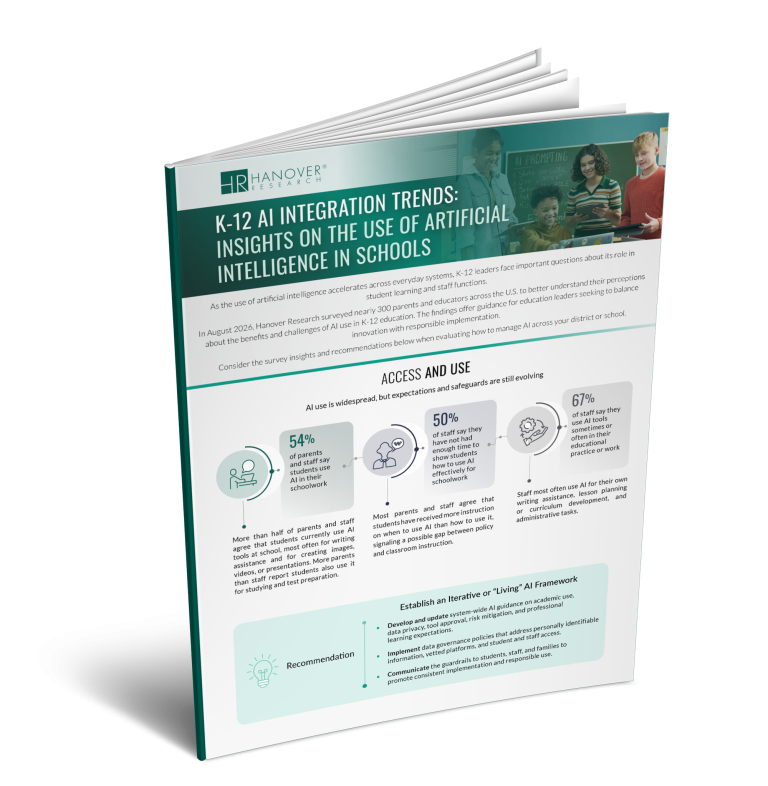
Artificial intelligence technology in schools is here to stay. Learn how to thoughtfully integrate AI into K-12 education with five practical tips.
Generative artificial intelligence, often simply called AI, has carved out a permanent place within schools. While AI tools have great potential to enhance teaching, learning, and operations, unmanaged use introduces significant risks. 84% of K-12 students now use AI technology, yet K-12 AI integration remains fragmented, with many schools and districts lacking clear policies or guidance that keeps pace with AI’s widespread use.
Without a systemwide AI integration plan, K-12 organizations risk facing learning disruptions, data security concerns, and being left behind in an evolving technological landscape. To prepare staff and students for the future, it’s critical for K-12 leadership to prioritize developing a comprehensive strategy for appropriately integrating AI into their districts and schools.
Drawn from real-world examples shared by experts during Hanover’s webinar, Navigating AI in Schools: Policies, Pitfalls, and Possibilities, the following five proven practices will help set your K-12 organization on the path to successful AI integration.
1. Start with a Clear Vision and Flexible AI Policy
A successful AI strategy begins with a shared vision that feels grounded in your community’s values, while still preparing staff and students for a rapidly changing future. K-12 organizations that co-create this vision with staff, students, families, and other community members build trust and increase buy-in from the start.
A strong, future-ready AI vision should articulate how AI will enhance, not replace, human connection in schools. Consider how AI can be used to strategically advance organizational goals such as personalized learning, operational efficiency, or improved data practices.
Your AI policy should translate that vision into a living, adaptable framework that outlines:
- Responsible use, ethics, and academic integrity expectations
- Data privacy and security requirements
- Guardrails that set boundaries for AI tools
- Permissions and limitations around when, where, and how AI tools may be used
Because AI tools evolve quickly, your policy should be designed for easy updates as new capabilities emerge, risks or compliance needs shift, or community expectations change. A clear vision paired with flexible policy gives staff and students confidence, helping them navigate AI safely and intentionally.
Build a comprehensive AI integration strategy with Hanover’s K-12 AI framework. Learn more.
2. Identify and Fill Operational Gaps for Improved Efficiency
Many of AI’s benefits extend far beyond the classroom. When used strategically, AI can reduce administrative burden, accelerate routine tasks, and free staff to focus more time on student-centered work within schools.
Begin with a targeted needs assessment to pinpoint gaps where AI could improve operational efficiency. K-12 organizations seeing success with AI integration consistently emphasize that human oversight when using AI for any task is non‑negotiable. AI can draft, recommend, and summarize, but staff must verify the accuracy of outputs and make final decisions.
Westport Public Schools, a district that champions successful AI use, has streamlined its operations with tools such as:
- Virtual Board of Education agent: A custom AI bot built by uploading years of board meeting videos that helps staff anticipate board questions, test ideas, and refine materials before meetings.
- Communication agent: Automates first drafts of press releases, analyzes social media sentiment, and helps leaders stay connected to community perceptions and concerns.
- Policy agent: A bot trained on district policy manuals and state statutes that quickly locates relevant requirements and can draft emails or documents aligned to official policy.
When K-12 organizations close operational gaps with AI, they reclaim valuable time, increase consistency, and enhance the quality of decision-making across the system. These operational improvements also lay the foundation for broader AI adoption, creating early wins that show staff how AI can reduce burdens rather than add to them.
Is your organization prepared to improve operations with AI? Take Hanover’s K-12 AI Readiness Diagnostic to assess your current approach and identify practical next steps. Start now.
3. Drive Educator AI Adoption Through Strategic Professional Learning
Educator adoption is essential because staff are the primary translators of any new tool into daily practice across classrooms. While many educators already use AI, levels of confidence and effectiveness still vary widely, especially when moving from basic use to high-impact applications.
Start by benchmarking AI literacy and conducting a needs assessment to understand how staff are using AI and where they need support. Surveys, focus groups, or conversations during staff meetings can surface what’s already working and where staff want clearer guidance. Use these insights to design professional learning that is aligned with educator needs and AI literacy levels.
To build momentum:
- Model and reinforce from the top: Leaders should build confidence in AI by regularly demonstrating practical use that’s tied back to the organization’s vision and guardrails.
- Anchor professional development in real workflows: Prioritize training and guidance for classroom and operational tasks and provide low-stakes time to test out tools with support.
- Scale through peer examples: Make time during staff meetings to spotlight what’s working, share prompts and processes, and normalize questions and iteration.
This needs-based professional learning approach accelerates the shift from experimentation to consistent practice, strengthening educators’ confidence in instructional and operational use and positioning AI as a tool that empowers their work rather than threatens it.
4. Elevate Student AI Literacy Beyond Basic Functions
Although most students are familiar with AI, many use AI tools only as a simple search engine or text generator. To truly prepare them for college, careers, and responsible digital citizenship, K-12 organizations must help students move beyond surface‑level use.
Start by clearly defining what AI readiness means for your organization. When crafting your definition, take workforce and college expectations into consideration. Then, embed AI literacy within existing curriculum rather than creating a standalone course. This keeps learning relevant and applicable to real academic tasks.
Key strategies include:
- Teaching students to treat AI as a thought partner, not a replacement for their own thinking
- Addressing ethical and responsible use, including the risks of academic dishonesty, the need to fact-check claims and verify sources, and understanding data privacy and digital footprints
- Encouraging use of AI to examine assumptions and explore alternative perspectives
- Designing separate grade‑, program‑, and subject‑specific guidelines for AI use
These approaches help students use AI to enhance learning, maintain academic integrity, and build skills that transfer into higher education and the workforce. This deeper level of AI literacy empowers students to become thoughtful problem solvers, ensuring they are ready to use AI responsibly and strategically.
Leverage AI technology to enhance learning and operations with insights from our 2026 Trends in K-12 Education report. Get the report.
5. Apply Proven Change Management Principles
While AI feels revolutionary, its integration relies on the same change management practices that have always worked when introducing new technologies in education.
Begin by assessing where your organization is now with AI adoption and where you want to be. Then, map the steps needed to bridge that gap. Throughout the process, ensure the focus is on supporting your organization’s larger mission and strategic goals through meaningful AI integration.
When K-12 organizations approach AI with the same intentionality used for other major shifts, such as the introduction of Multi‑Tiered Systems of Support frameworks or standards-aligned curriculum adoption efforts, they reduce uncertainty. This reinforces the idea that AI is not a disruptive, unwelcome addition, but instead a thoughtful enhancement to existing organizational priorities.
Moving Toward Strategic, Systemwide K-12 AI Integration
Despite widespread AI usage in K-12 education, only 33 U.S. states and Puerto Rico have issued any official AI guidance for schools to date. It’s evident that ignoring or banning AI in schools has the potential to worsen its risks, rather than mitigate them. Without direction, students and staff turn to AI tools independently, without guardrails to ensure safe and responsible use.
K-12 leaders now have a critical opportunity to shape how their communities navigate this technology. Each organization’s path will look different, but the foundational practices outlined here will help you build a responsible, effective AI integration strategy that thoughtfully prepares your staff and students for the future.