Discover how districts and schools are embracing innovation in AI, data analysis, and career readiness to improve K-12 student outcomes.
As funding, policy, and technology pressures create new challenges in K-12 schools, they also bring opportunities to reimagine what’s possible in classrooms. While education leaders are navigating growing operational complexities, it’s imperative for them to maintain a clear focus on improving K-12 student outcomes, keeping academic achievement and student well-being at the core of their planning.
In 2026, rather than waiting for solutions to appear, proactive districts and schools are actively testing new frameworks, adopting better technologies, and modernizing their curricula. They’re learning how to leverage artificial intelligence to enhance learning, use data as a powerful ally to measure impact, and realign resources to prepare students for the careers of tomorrow.
For your K-12 organization to stay ahead of the curve, it’s essential to understand these shifts. By looking at the strategies other successful districts and schools employ, you can map out a practical path forward for your own community.
Explore three of the top five emerging education trends below, drawn from Hanover’s 2026 Trends in K-12 Education report.
Accelerating Student Learning with Artificial Intelligence (AI) Frameworks
AI is rapidly reshaping the educational landscape, and K-12 organizations recognize the urgent need to adapt.
Most districts and schools this year are exploring ways to integrate AI-driven innovation across teaching, learning, and operational processes. However, successful adoption requires thoughtful guidance that treats AI as a systemwide change rather than a passing fad.
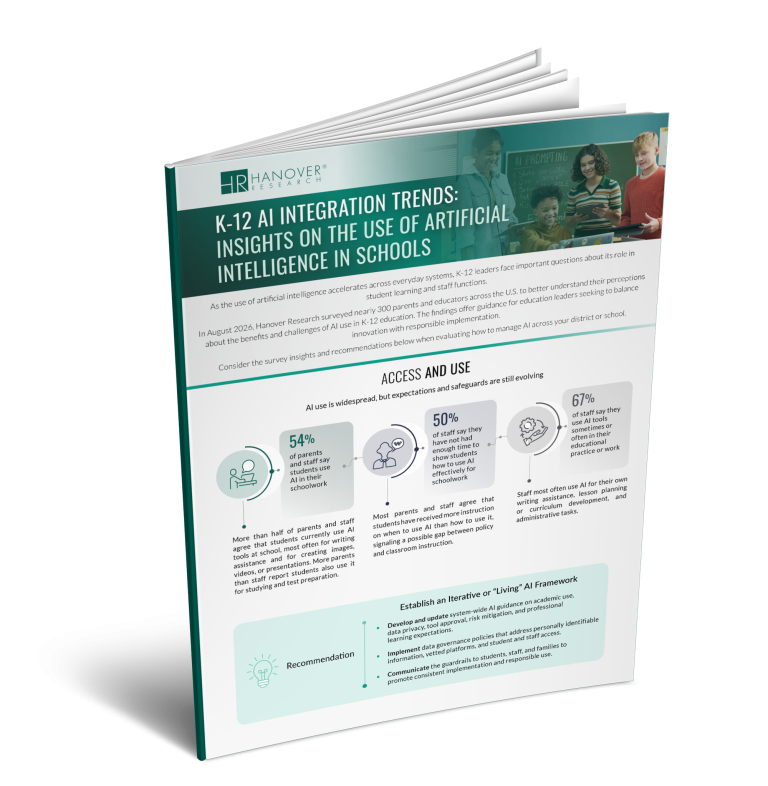
Research shows that 40% of K-12 employees report their school or district lacks an official AI policy. Furthermore, just 19% of students say their teachers have taught them how to use AI for schoolwork. When guided by data-informed research, AI offers vast possibilities to elevate instructional practices and streamline organizational efficiency. Without clear frameworks, however, these benefits can easily be overshadowed by risks related to ethics, academic integrity, and data privacy.
To ensure AI serves as a catalyst for long-term improvement and deeper student learning, schools are implementing the following strategies:
Form a Collaborative AI Team
Gather a diverse group to co-create a shared vision for AI integration. This team should include administrators, teachers, parents, and students to work together to establish clear AI goals, develop community engagement practices, and build an evaluation plan that aligns with your organization’s core values.
Build Iterative Guidance and Policies
Establish a guiding framework or acceptable use policy that clearly defines how AI technology should and should not be used in teaching, learning, and operations. Use simple, direct language and design procedures that can be adapted over time. Because AI evolves so quickly, your policies must remain flexible enough to accommodate future technological advancements.
Provide Ongoing, Embedded Training
Plan continuous professional learning to train teachers and staff on AI best practices. Focus on practical student engagement methods and specific tools that enhance classroom instruction as well as automate routine tasks. When educators feel confident using new technology, they are far more likely to integrate it effectively into their daily routines.
Want to assess how prepared your organization is to put these AI practices into action? Take our K-12 AI Readiness Diagnostic.
Validating K-12 Student Outcomes Through Strategic Data Collection
In 2026, the urgency to understand impact and return on investment is pushing more K-12 organizations to develop data processes. In a resource-scarce environment, more districts and schools are investing in data collection and analysis to pinpoint exactly which initiatives drive student success. This evidence-based approach empowers leaders to make more effective strategic budget planning decisions that move the needle on student outcomes.
Despite the obvious benefits of data-driven decision-making, building capacity remains a challenge. A recent survey revealed that only 17% of teachers learned how to use data effectively during their educator preparation programs.
To make accurate decisions about programs and budgets, K-12 organizations need access to quality data sources and expertise to interpret them. Organizations with a strong culture of data literacy have an easier time reducing silos, prioritizing collaboration, and establishing stronger accountability measures.
Many educational leaders are taking the following concrete steps to build a robust data culture that directly improves student outcomes.
Establish Dedicated Data Teams
Form a specialized data team to develop and implement improvement strategies. This group should use an iterative model of data inquiry, analysis, and monitoring. By assigning clear roles and processes, you ensure that data collection translates directly into actionable instructional changes.
Conduct a Comprehensive Data Inventory
Take inventory of the data sources currently accessible within your organization. Identify any gaps, redundancies, or inaccuracies to improve overall data quality. When leaders know exactly what information is available, they can ask better questions and design more targeted interventions for struggling student populations.
Assess and Address Data Literacy Needs
Conduct a needs assessment to understand your employees’ current comfort levels with data analysis and interpretation. Use these findings to inform tailored professional learning plans. Training should emphasize not just technical skills, but also the ability to ask the right questions and connect raw data to daily instructional strategies.
Turn more data into action by increasing your staff’s ability to interpret and use data insights. Download our detailed infographic, K-12 Data Literacy Checklist.
Elevating Career and Technical Education (CTE) Outcomes
As workforce skills evolve, many K-12 organizations are expanding career-related learning experiences to help students prepare for a wider array of future jobs. Retooling and modernizing college and career preparation is essential for student success, especially as emerging technologies like AI are changing career outlooks.
Today, over 11.2 million high school students are enrolled in CTE programs across the country, learning practical skills that bridge the gap between graduation and employment.
To design industry-aligned learning opportunities, many K-12 organizations are strengthening their partnerships with employers and postsecondary institutions. However, others still have room to grow. In fact, just 43% of CTE educators say their school uses job growth projections to make programming decisions, and 40% of CTE leaders struggle to secure employer partnerships due to scheduling or liability challenges.
By revamping CTE programs to align with emerging labor market needs, districts and schools can design real-world learning and facilities that help students imagine their futures and prepare for jobs and careers in high-demand fields.
Here are some of the ways that districts and schools are modernizing their career and workforce readiness programming:
Align CTE with Strategic Goals
Collect baseline data on your current CTE programs, including enrollment patterns and graduation outcomes. Integrate specific CTE objectives into your broader strategic plan and track those metrics consistently over time. When career readiness becomes a core priority, funding and administrative support follow.
Conduct a Thorough Labor Market Analysis
Gather and analyze national and regional employment data to identify high-growth, high-demand occupations projected for the next five to ten years. By understanding which industries offer living-wage jobs, schools can adjust their course offerings and training opportunities to better serve both students and local employers.
Revamp CTE Professional Development
Provide your CTE educators with targeted professional learning and resources they need to integrate high-demand technology into their courses. Because industries like healthcare, manufacturing, and agriculture are rapidly adopting data analytics and robotics, teachers must stay informed about emerging industry standards to effectively prepare their students.
Turn your strategic planning — and limited resources — into effective actions with insights from Hanover’s toolkit, Transforming Strategic Plans into Results.
Turning Uncertainty into Strategic Advantage to Improve Student Outcomes
Despite rising challenges, districts and schools have the power to enact meaningful change for students. By focusing on three core areas — thoughtful AI integration, prioritizing data analysis, and modernizing CTE and workforce readiness — education leaders ensure their decisions in 2026 and 2027 will align with long-term student-centered improvement goals.
The transition toward a more innovative, responsive educational model undoubtedly requires vision, courage, and a commitment to continuous improvement. But with a data-informed approach, K-12 leaders can adapt swiftly, allocate resources wisely, and turn uncertainty into a strategic advantage. Use 2026 as a fresh opportunity to reimagine what’s possible for your students and community.