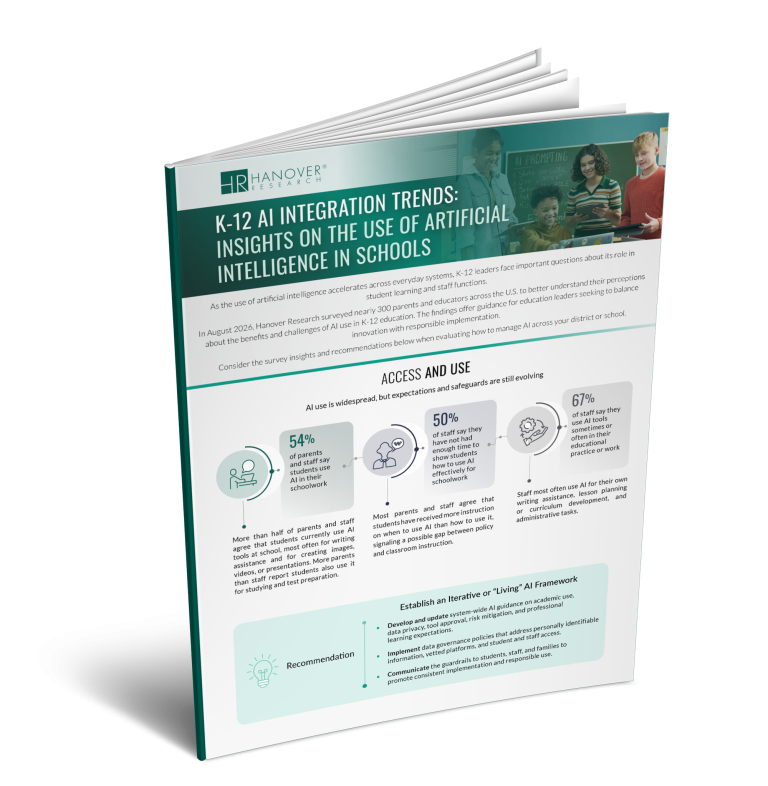
Use our AI survey findings to discover how students and staff are using artificial intelligence in schools in 2026, and where gaps remain.
As the use of artificial intelligence (AI) accelerates across everyday systems, K-12 leaders face important questions about its role in student learning and staff functions. In August 2026, Hanover Research surveyed nearly 300 parents and educators across the U.S. to better understand their perceptions about the benefits and challenges of AI use in schools.
The findings from this survey offer guidance for education leaders seeking to balance innovation with responsible AI implementation and oversight.
Download our infographic, K-12 AI Integration Trends, to consider how AI is affecting teaching and learning, including:
- Student and staff access and use
- Trending beliefs and concerns
- Professional learning needs and preferences
- The importance of gathering local AI perceptions and use cases
“Most parents and staff agree that students have received more instruction on when to use AI than how to use it, signaling a possible gap between policy and classroom instruction.”
How Is AI Currently Being Used in Schools?
Whether districts or schools ban the use of artificial intelligence or are eagerly integrating it into teaching, learning, and operations, it’s clear that AI is already reshaping the student and staff experience. For example:
- 54% of parents and staff say students use AI tools for schoolwork
- Only 50% of staff feel they’ve had enough time to teach students how to use AI effectively
- 67% of staff want more AI training and support
In 2026–27, it’s critical for districts and schools to approach AI integration strategically, with clear goals, guardrails, and staff support.
Understanding how AI is affecting students, staff, and families by conducting a district or school survey is the first step in designing an effective and lasting K-12 AI framework.
Hanover Research’s infographic distills the latest data and insights on how schools are adopting AI tools, where adoption is accelerating, and what barriers stand in the way.